Bičiktu-Boom II/1 (A-14)
Description
The inscription was found in the vicinity of the village Bičiktu-Boom in the Republic Altai. A local person T. I. Sabaeva showed this inscription to a Kazakh Turcologist Sejdakmatov in 1964. There is also a third line on that stone which we consider to be an independent inscription (see Bičiktu-Boom II/2); here, we agree with Kyzlasov (2000: 92).
In the seventies of the twentieth century, this inscription was brought to the National Museum of the Republic Altai; that saved it because shortly after that many inscriptions of that rock got destroyed as a result of a road construction.
There are a few interpretations of this inscription; see Sejdakmatov 1964: 101; Tenišev 1966: 264–265; a full description and an analysis of the proposed readings are presented in Tybykova, Nevskaya & Erdal 2012: 55-56. Here we cite only the interpretation of Igor’ Kyzlasov (2000: 92)
Reading of K. Sejdakmatov
Transliteration:
1) НьРьГьҮ?А
2) ЭТьДьМП
3) КьЫШЫУГЛьҢьГь
Transcription:
1) …
2) этдим п...
3) киши уг элиңиг
Translation:
1) ….
2) I did.
3) your nation, tribe, people, ...
(Sejdakmatov 1964: 101)
Comments
1. The reading of the third line makes no sense, as the nouns are not connected with each other in any way.
2. The author of this interpretation considers that we have group inflexion here, and that the affix of the 3rd person refers to all the three members of this row. According to him, the third member has the affix of the accusative -ig. However, this reading is ungrammatical as the accusative affix after the possessive affixes should be -nI.
Reading of Ė. R. Tenišev
Transcription:
1) n(ä) (ä)r(i)g ögä;
2) (ä)b (ä)td(i)m i(ä?)
3) kiši oγul aŋ äg
Translation:
1) which man prising
2) I organized the house,
3) wife, children, hunting, clothes
(Tenišev 1966: 264–265)
Comments
The problem is that the last but one character in the first line is likely to be r2, not g2.
Reading Of I. L. Kyzlasov
Transliteration:
1) n²r²gö(ü)r²ä(a)
2) b2t2d2mä(а)
Transcription:
1) en erig ör
2) bitidim
Translation:
1) [My God,] stand out in front of a sinful man!
2) I have written (this).
(Kyzlasov 2000: 92)
Comments
We do not agree to this interpretation on several reasons. The word en ‘low’ is rare in Old Turkic; it is met only in DLT and only concerning the landscape, but not applying to a person in the meaning ‘sinful’ as this interpretation presupposes (see EDPT). The verb ör- ‘ascend, go upwards’ is intransitive; it cannot be used with an accusative object, i.e. this interpretation is ungrammatical. The translation proposed by Igor’ Kyzlasov is even more doubtful because he imagines that this was a direct address to the God to appear in front of the sinful man who wrote those lines.
Reading of L.N.Tybykova,
I.A. Nevskaya and M. Erdal
Runic transliteration:
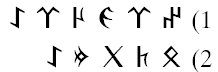
Transliteration:
1) n2 r2 g2 Ü r2 A
2) b2 t2 d2 m A
Transcription:
1) n(ä) (ä)rgü (ä)r !
2) b(i)t(i)d(i)m !
Translation:
1) a person who will become (someone) / what creating
2) I wrote.
Comments
1. The first line can be interpreted in various ways. Firstly, it can be a name of the person who wrote the inscription. It can be also read as n(ä) (ä)rgü (ä)r a ‘a person who will become (someone) where –gü is the obligation participle affix added to the verbal base är- ‘be’. However, ärgür-ä could be the vowel converb of the causative verb ärgür- ‘cause to be, create’: (ä)r-gür-ä be-causative-converb.
2. The second line is, most probably, bitidim a! ‘I wrote!’ with the rune A used as punctuation sign. This is a frequent feature of Old Turkic inscriptions of this region. Sometimes it is also used as a word divider. We can mention that the same sequence of characters can also be read as (ä)v (e)td(i)m ‘I built a house’, but considering the Altai context where we have many visitor’s inscriptions this interpretation is less likely than the first one.